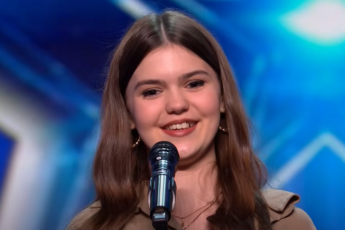
Fourteen-year-old Gabz from London stepped onto the Britain’s Got Talent stage with a kind of easy, natural confidence that immediately set her apart. Dressed in a bright, colorful onesie, she brought a playful energy with her that felt both youthful and self-assured. There was no sense of hesitation in the way she carried herself—just excitement and a quiet belief in what she was about to do. When she introduced her performance, she revealed that she would be singing an original song called “The One,” which she had written herself after only two years of playing the piano. That detail alone caught the judges’ attention. Writing your own material is always a risk on a stage like this, but doing it at just fourteen made it even more impressive.
What made the moment even more interesting was the theme of her song. When asked about it, Gabz explained that it was about losing the love of your life—a surprisingly mature topic for someone her age. But she quickly balanced that seriousness with a touch of humor, admitting that her inspiration came mostly from watching movies rather than personal heartbreak. That small comment not only lightened the mood but also showed her creativity. She wasn’t just copying what she saw—she was taking ideas, emotions, and stories from outside sources and turning them into something of her own. It revealed a level of imagination and storytelling ability that went beyond her years.
As the performance began, Gabz sat at the piano and started singing her original melody. The song had a soft, catchy opening that immediately drew people in. Her voice carried a gentle warmth, and there was something very genuine about the way she delivered each line. It didn’t feel forced or overly rehearsed—it felt natural, like she truly enjoyed what she was doing. The melody was simple but effective, the kind that stays in your head without you even realizing it.
Then, just as the audience settled into the rhythm of her piano and vocals, she surprised everyone by transitioning into a rap verse. It was smooth, confident, and completely unexpected. That shift added a new layer to the performance, showing that she wasn’t limited to just one style. Instead, she blended singing and rapping effortlessly, creating a performance that felt modern, fresh, and full of personality. It’s not easy to balance those elements, especially live, but Gabz handled it with ease.
The chorus was where the song truly came alive. With the line about putting “lighters in the air if you’ve ever felt scared ’cause you’ve lost the one,” she created a moment that felt both emotional and catchy at the same time. It had that rare quality of being relatable while also sounding like something you could hear on the radio. You could almost imagine a crowd singing along to it at a concert. Despite her young age and limited experience, the structure of the song felt polished and thoughtfully put together.
The audience responded almost instantly. People began clapping along, smiling, and getting caught up in the rhythm. There was a sense of shared enjoyment building in the room, as if everyone realized they were witnessing something special. It wasn’t just about technical skill—it was about connection, energy, and originality.
When the performance ended, the judges’ reactions made it clear that Gabz had left a strong impression. Alesha Dixon was particularly enthusiastic, praising the combination of piano and rap and calling the act “cool and different.” Amanda Holden focused on the song itself, highlighting how incredibly catchy the chorus was. Both seemed genuinely excited by what they had just seen.
Simon Cowell, known for being the toughest critic on the panel, gave a more measured but still positive response. He pointed out that Gabz might not be the strongest piano player technically, but that wasn’t the main point. What mattered, he emphasized, was the song. He described the chorus as “great” and suggested that, with the right production, it could turn into something really special. Perhaps most importantly, he noted her likeability—something that can’t be taught—and predicted that the song would stay in their heads long after the audition ended.
In the end, Gabz received four unanimous “Yes” votes, a clear sign that the judges saw real potential in her. It wasn’t just about what she had done in that moment, but what she could become in the future. With her originality, confidence, and natural creativity, she didn’t just perform—she introduced herself as a young artist with something unique to offer.