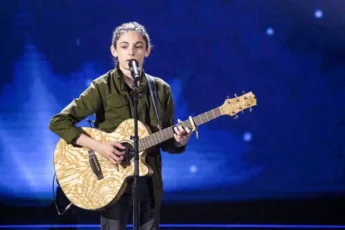
Fourteen-year-old Dylan Zangwill from Exton, Pennsylvania, walked onto the America’s Got Talent stage with a presence that was easy to overlook at first. He didn’t come in with loud confidence or flashy energy—instead, he carried himself quietly, almost cautiously, as if he’d rather blend into the background than stand in the spotlight. When the judges began speaking with him, Dylan admitted something that made him instantly relatable: he wasn’t someone who liked talking about himself. At school, people knew he was into music, but beyond that, he preferred listening over speaking, observing rather than performing socially. It was clear he wasn’t there to impress with words. Whatever impression he would make would come from what he was about to do at the piano.
That contrast—the quiet boy versus the bold song choice—immediately sparked curiosity. Sitting down at the piano, Dylan prepared to perform a classic blues-rock track, a genre known for its intensity, grit, and emotional depth. It wasn’t the kind of song most people would expect from someone so reserved, especially a teenager. For a brief moment, there was a sense of uncertainty in the room, as if no one quite knew what to expect. Then he began to play.
What followed was nothing short of a transformation. From the very first notes, Dylan seemed to step into a completely different version of himself. The hesitation disappeared. His posture changed, his expression sharpened, and his energy surged forward. As he started singing, the shift became undeniable. His voice came out strong, raw, and full of soul—far beyond what anyone anticipated. It wasn’t just technically good; it carried weight, emotion, and a kind of lived-in quality that made it feel authentic.
The performance built quickly, drawing the audience in with its intensity. Dylan didn’t hold back. He leaned into the music, letting the rhythm guide him, his fingers moving confidently across the piano keys. His voice rose and fell with the song’s demands, at times gritty and powerful, at others controlled and expressive. It felt like he wasn’t just performing a song—he was channeling something deeper through it. The kind of passion he displayed made it clear that this wasn’t just a hobby for him; it was where he felt most alive.
The audience responded almost immediately. You could see people sit up straighter, exchange surprised glances, and gradually become fully absorbed in what was happening on stage. There’s something especially compelling about watching someone break expectations in real time, and Dylan did exactly that. The shy teenager who didn’t like talking about himself had suddenly become the most commanding presence in the room.
By the time he reached the peak of the performance, the energy in the theater had completely shifted. It wasn’t just applause—it was genuine excitement, the kind that builds when people realize they’re witnessing something special and unexpected. And when the final notes rang out, the reaction was immediate and enthusiastic.
The judges were just as impressed as the audience. Sofia Vergara was quick to point out how surprising the transformation was, calling the performance “spectacular” and highlighting the contrast between his gentle personality and the power of his voice. Simon Cowell, known for his critical eye, didn’t hesitate to praise the audition, calling it “great” and emphasizing that Dylan was “definitely something to watch.” It wasn’t just about the performance itself—it was about the potential he clearly had moving forward.
Heidi Klum added another layer to the praise by mentioning that Dylan writes his own songs, which made the moment even more meaningful. It showed that his talent wasn’t limited to performing; he had creativity and artistry of his own, something that could develop even further with time. The judges recognized not just what he had done, but what he could become.
In the end, the decision was unanimous. Four clear, confident “Yes” votes secured Dylan’s place in the next round. But more than that, he left the stage having done something far more important—he showed who he truly was through his music. Without needing to say much at all, he proved that sometimes the quietest people have the loudest, most unforgettable voices when they finally choose to be heard.