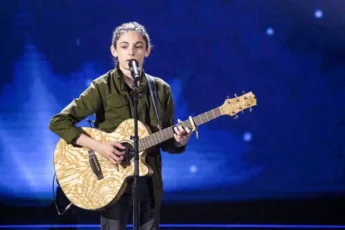
Moya Angela, a 32-year-old teacher from Las Vegas, walked onto the America’s Got Talent stage carrying more than just nerves—she carried years of quiet sacrifice, self-doubt, and a dream she had put on hold for far too long. For most of her adult life, she had dedicated herself to helping underprivileged students, pouring her energy into making a difference in their lives. While that work gave her purpose, it also meant that her own aspirations often took a backseat. Standing under the bright stage lights, she made a conscious decision: this moment was finally about her.
From the very beginning, Moya’s presence felt genuine and relatable. She spoke openly about her journey, explaining how singing had always been a part of her life. As a young girl, she found joy in her church choir, where music became both an escape and a form of expression. But as she grew older, life became more practical. Responsibilities took over, and the dream of becoming a professional singer slowly faded into the background. Like many people, she began to question herself—was her voice really good enough? Did she truly belong on a stage like this?
Those doubts were still visible as she stood in front of the judges. You could see it in the way she held the microphone, in the slight tremble of her voice as she introduced herself. Yet beneath that nervousness was determination. She wasn’t just there to perform; she was there to prove something to herself. She even said she wanted to “stand on her own two feet,” a simple phrase that carried so much weight considering everything she had put aside for others.
Choosing a song like Celine Dion’s “It’s All Coming Back to Me Now” was a bold move. It’s a notoriously difficult piece, one that demands not only technical skill but also deep emotional connection. From the first note, however, it became clear that Moya wasn’t intimidated. She began softly, almost cautiously, easing into the melody as if testing the waters. But as the performance progressed, something shifted.
Her confidence grew with each line. The softness gave way to strength, and her voice expanded into something powerful and commanding. She navigated the song’s challenging range with impressive control, effortlessly moving between delicate moments and soaring high notes. What made it even more compelling was the emotion behind it. You could feel that she wasn’t just singing the lyrics—she was living them, channeling her own story into every phrase.
By the time she reached the climax of the song, the entire atmosphere in the room had changed. The audience, who had been quietly attentive at the start, was now fully engaged. People leaned forward, eyes wide, completely drawn in. When she hit the final notes—strong, clear, and full of conviction—the reaction was immediate. The crowd erupted into applause, rising to their feet in a standing ovation that felt both spontaneous and well-deserved.
The judges’ reactions mirrored the audience’s excitement. Simon Cowell, known for his sharp critiques, didn’t hesitate. “That’s what we call a singer!” he said, a statement that carried significant weight coming from him. He emphasized how she had taken full advantage of her time on stage, delivering a performance that people wouldn’t easily forget. Howie Mandel added that she seemed completely at home on that stage, saying she was “born to be there.” Mel B highlighted something equally important—Moya had taken a song that everyone knows and made it feel fresh and personal, which is no easy task.
What made the moment even more special was the visible support from her family. You could see the pride in their faces, the emotion in their reactions. For them, this wasn’t just a performance—it was the realization of something Moya had carried inside for years.
When the judges delivered their votes, all four said “Yes” without hesitation. It was a clear and unanimous decision, but more importantly, it felt like validation—not just from the judges, but from the world watching. Moya Angela had stepped onto that stage as a teacher who once doubted herself, and she walked off as a performer who had just reminded everyone, including herself, of her true potential.
Her story resonates because it’s so human. So many people put their dreams aside, convincing themselves that it’s too late or that they’re not good enough. Moya’s audition serves as a powerful reminder that passion doesn’t disappear—it waits. And sometimes, all it takes is one brave moment to bring it back to life.