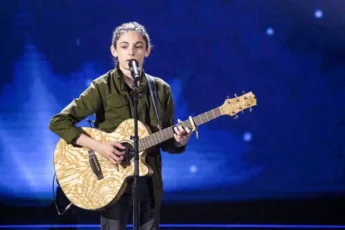
Hunter Price, a 25-year-old singer from Georgia, walked onto the America’s Got Talent stage with a guitar and a dream, hoping to impress the judges with his voice. For his audition, he chose the famous Bryan Adams song “Everything I Do.” It was a safe and familiar choice, the kind of emotional classic that many singers use to show their vocal ability. At first, it seemed like he was trying to give the judges something beautiful and recognizable. But very quickly, the performance began to feel too ordinary.
Although Hunter had a pleasant voice, the song did not reveal much about him as an artist. It sounded polished enough, but it lacked personality and originality. Instead of feeling like a powerful moment, it came across as something the judges had already heard many times before. Simon Cowell noticed this almost immediately. In the middle of the audition, he suddenly stopped the music, creating a tense and uncomfortable silence in the room.
Simon was very direct with Hunter. He told him that the performance sounded “very generic” and compared it to something he had heard a “million times” in karaoke competitions. For any contestant, especially someone standing on such a huge stage, that kind of criticism could be crushing. Hunter looked nervous, and for a moment, it seemed like his audition might be over before it had really begun. However, instead of sending him away, Simon gave him an unexpected second chance. He asked if Hunter had an original song he could perform.
That question completely changed the audition. Hunter explained that he had been writing his own music and that he was inspired by artists like Taylor Swift, who are known for turning personal experiences into songs. This small detail made the judges see him differently. He was no longer just a singer covering a famous ballad. He was someone who might have his own story, his own emotions, and his own voice as a songwriter.
Hunter then began performing his original song, “Left Behind.” Almost immediately, the mood in the room shifted. This performance felt much more honest and natural than the first one. He no longer seemed like he was trying to copy someone else or choose the safest possible song. Instead, he sounded like a real artist sharing something personal. The melody was simple but memorable, and the lyrics carried emotion. There was pain in the song, but also sincerity, which made it much easier to connect with him.
The meaning of the song became even stronger when Hunter opened up about his life. He shared that he had been on his own since the age of 18 and had experienced difficult times, including moments when he did not have enough money to eat. That detail gave his performance more emotional weight. Suddenly, “Left Behind” did not feel like just another sad song. It felt connected to real struggle, loneliness, and survival. The audience and judges could understand that he was singing from experience.
The judges quickly realized they had seen two very different sides of the same contestant. The first performance made Hunter seem forgettable, while the second showed depth, honesty, and real potential. Sofía Vergara even admitted that if she had only heard the first song, she would have said no. But after hearing his original work, her opinion changed, and she gave him a yes.
Howie Mandel was still slightly unsure, but he gave Hunter useful advice. He encouraged him to open up more and be more genuine, suggesting that Hunter’s real power came from honesty, not from trying to please everyone. Simon Cowell seemed to agree with that idea. He told Hunter that he was a better songwriter than he probably realized and pointed out that his biggest problem was trying too hard to give people what he thought they wanted.
In the end, Hunter received three yeses from the judges and moved forward in the competition. But the audition was about more than just passing to the next round. It became a clear example of how important authenticity is in music. Hunter almost lost his chance because he started with a song that hid who he really was. But when he performed his own music, he showed the judges something real. His second chance turned into a powerful reminder that sometimes the most memorable performances come from being brave enough to tell your own story.