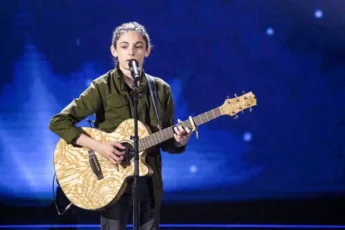
When 11-year-old D’Corey Johnson stepped onto the America’s Got Talent stage, he brought more than just a song with him. He brought a dream that felt much bigger than his age. Coming from Louisville, Kentucky, D’Corey introduced himself with a bright smile, a calm confidence, and the kind of personality that immediately made the judges and audience want to listen. He shared that his biggest dream was to perform on Broadway one day, especially in major shows like Hamilton and Wicked. For a child his age, that kind of goal says a lot. It shows ambition, imagination, and a deep love for performing.
Before the audition began, D’Corey had a sweet and funny moment with the judges. When asked about the panel, he said Simon Cowell was his favorite judge because Simon “keeps it real.” The comment made everyone laugh, and it also showed that D’Corey was not easily intimidated. Simon has a reputation for being honest, sometimes brutally so, but D’Corey seemed to respect that. He even told the audience that he believed he had what it takes to win the whole competition. It was a bold thing to say, but coming from him, it felt innocent, hopeful, and sincere rather than arrogant.
For his audition, D’Corey chose “Open Arms” by Journey, a classic song filled with emotion. It is not an easy song for anyone, especially an 11-year-old. It requires control, warmth, and the ability to make the lyrics feel real. At first, he began singing with the background music behind him. The performance had promise, and his voice clearly had strength, but something about the track seemed to be getting in the way. Instead of letting the song continue, Simon suddenly stopped him.
That moment could have shaken almost anyone. Standing on a huge stage in front of bright lights, cameras, celebrity judges, and a packed audience is already stressful. Being stopped in the middle of a song makes it even harder. For a young singer, it could have felt embarrassing or frightening. But Simon was not trying to ruin the audition. He explained that the backing track was distracting and that he wanted to hear D’Corey’s real voice more clearly. Then he asked him to sing the chorus again, but this time completely a cappella.
No music. No backup. No safety net. For a few seconds, the room felt tense. Everyone seemed to understand how much pressure had just been placed on this young boy. Singing without music exposes everything. Every note, every breath, and every small mistake becomes easier to hear. But D’Corey did not crumble under the pressure. He stood there, took in the moment, and began again.
That second performance changed everything. Without the track, D’Corey’s voice sounded stronger, clearer, and much more emotional. The audience could finally hear the natural quality of his tone and the feeling behind the words. What had started as a good audition suddenly became something memorable. His voice did not need heavy music or production to stand out. In fact, the silence around him made the performance feel even more powerful. It was raw, honest, and surprisingly mature for someone so young.
The judges were visibly impressed. Sofia Vergara pointed out that “less is more,” praising how much better he sounded when the music was taken away. Her reaction captured exactly what many people in the room were feeling. Sometimes a simple performance can be more moving than a polished one, because it lets the singer’s heart come through.
Simon, who had created the difficult moment by stopping the song, was also impressed. He told D’Corey that he had a distinctive, great voice and said his future would be amazing. Coming from Simon, those words meant a lot. He had challenged D’Corey, and D’Corey had passed that challenge with grace.
By the end, the audience was on its feet. D’Corey received four enthusiastic “yes” votes from the judges, sending him forward in the competition. Overcome with emotion, he began to cry, and it was easy to understand why. He had walked into the audition with confidence, faced a moment that could have ended badly, and turned it into the highlight of his performance. His audition proved that sometimes being asked to start over is not the end of the dream. Sometimes, it is the exact moment the dream begins to feel real.