
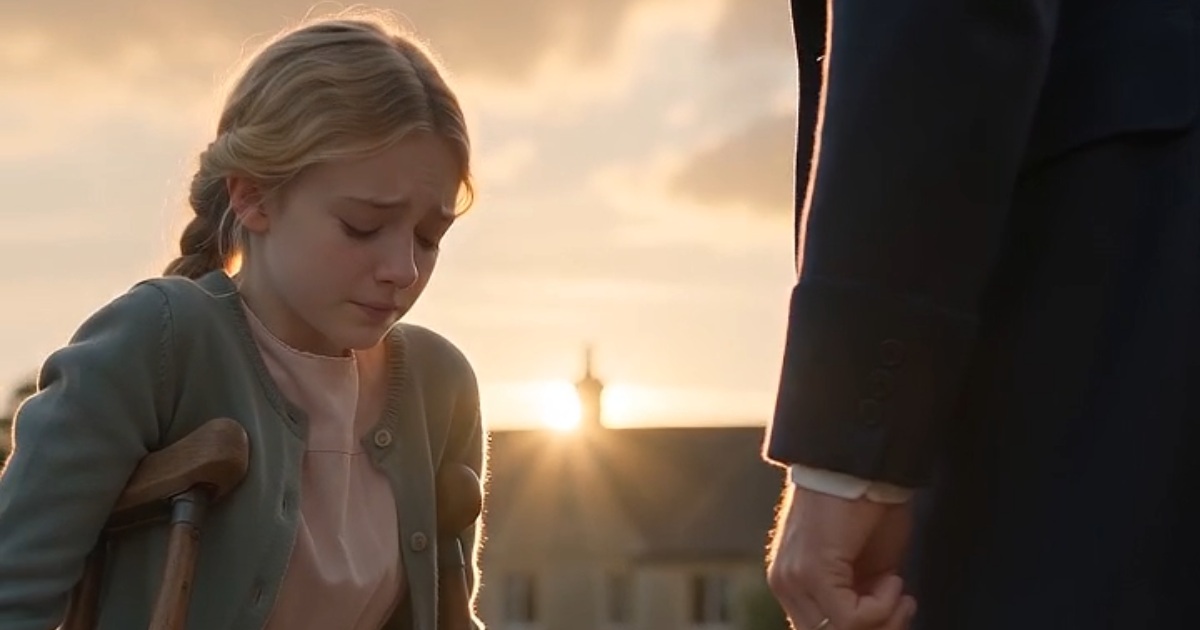
Clara’s father stared at the barefoot boy.
“What do you mean her legs were never the reason?”
The boy lowered his head.
“My mother said someone in this house was keeping Clara sick.”
The words struck Richard like lightning.
“What did you just say?”
The boy nervously touched the red scarf around his wrist.
“She told me that if I ever saw Clara again, I should help her. She said Clara wasn’t as helpless as everyone believed.”
Richard stepped closer.
“Who is your mother?”
“Maria.”
Richard froze.
Maria had been Clara’s nurse for nearly five years.
She had disappeared six months earlier after being accused of stealing expensive jewelry from the mansion.
His wife, Vanessa, had insisted Maria was dishonest.
Richard had believed her.
“Where is Maria now?” he asked.
The boy’s eyes filled with tears.
“She died three months ago.”
Richard felt his chest tighten.
“Before she died, she told me to find Clara. She said there was something hidden in her old room.”
Suddenly, a voice rang out behind them.
“Richard! Get that filthy child away from our daughter!”
Vanessa stood at the garden entrance.
Her face was pale.
And when she saw the red scarf around the boy’s wrist, her expression changed completely.
“Where did you get that?” she demanded.
The boy stepped backward.
“It was my mother’s.”
Vanessa looked at Richard.
“He’s lying! Maria was a thief!”
But Clara suddenly spoke.
“No, Mommy.”
Everyone turned.
The little girl was trembling.
“Maria never hurt me.”
Vanessa forced a smile.
“Sweetheart, you don’t understand.”
Clara shook her head.
“She used to help me stand when you weren’t home.”
Richard stared at his daughter.
“What?”
Clara began crying.
“Maria said I was getting stronger. But then she disappeared, and Mommy told me I wasn’t allowed to practice anymore.”
Vanessa’s face went white.
“Clara, stop talking.”
Richard turned toward his wife.
“Why would you stop her therapy?”
Vanessa said nothing.
Then the boy reached into his pocket.
He pulled out a small, folded envelope.
“My mother told me to give this to Clara’s father.”
Richard opened it.
Inside was a handwritten letter.
Dear Mr. Whitmore,
I know you believe I stole from your family. I didn’t.
I was dismissed because I discovered something I wasn’t supposed to see.
Clara was making progress. Her doctors had recommended continued rehabilitation, and I witnessed movements that gave us reason to hope.
But Mrs. Whitmore repeatedly canceled her appointments and told me never to mention Clara’s improvements to you.
I kept copies of the medical reports.
Please, for your daughter’s sake, find them.
Maria.
Richard looked up slowly.
“Vanessa… what have you done?”
His wife began shaking.
“I was protecting her!”
“From what?”
“From disappointment! From doctors giving her false hope!”
Richard’s voice broke.
“You let our daughter believe she had no future!”
Vanessa burst into tears.
“You don’t understand! Clara needed me. Every time she improved, everyone talked about how independent she could become. I was terrified she’d stop needing me.”
Richard stared at her in disbelief.
“You made her afraid to try because you were afraid of losing her?”
Vanessa covered her face.
But the boy wasn’t finished.
“My mother kept something else.”
He reached into his pocket again and handed Richard a small key.
“She said it opens the drawer in her old room.”
Richard immediately went inside.
In Maria’s former bedroom, he found a locked wooden drawer.
Inside were medical reports, therapy notes, and photographs.
One photograph showed Clara standing between two support bars, smiling proudly.
The date was nearly a year old.
Richard sat on the edge of the bed.
His daughter had made progress.
And no one had told him.
He immediately contacted Clara’s medical team and arranged an independent evaluation.
The doctors were cautious.
They explained that Clara had a complex neurological condition. The movement in her toes was encouraging, but it did not mean she would suddenly be able to walk.
With appropriate rehabilitation, however, she might regain additional strength and mobility.
There were no guarantees.
But there was hope.
And that was something Clara had been denied for far too long.
Richard separated from Vanessa while the authorities investigated the allegations involving Clara’s care and Maria’s dismissal.
He also discovered that Maria had spent her final months living in poverty, struggling to support her son.
The boy’s name was Daniel.
He was only ten.
And after his mother’s death, he had been moving between temporary shelters.
Richard found him sitting outside the mansion that evening.
“Daniel,” he said gently, “why did you come here?”
The boy looked down.
“Because my mom made me promise.”
“Promise what?”
“That I wouldn’t let Clara give up.”
Richard’s eyes filled with tears.
“Your mother was a remarkable woman.”
Daniel wiped his face.
“She always said Clara was brave. She said she just needed someone to believe in her.”
Richard knelt beside him.
“Then I think we owe your mother something.”
Daniel looked confused.
“What?”
“We’re going to make sure Clara gets every chance she deserves.”
Over the following months, Clara began working with a new rehabilitation team.
Some days were encouraging.
Others were exhausting.
Sometimes she cried because the exercises hurt.
Sometimes she wanted to quit.
And whenever that happened, Daniel reminded her of the words his mother had taught him.
“Just try.”
Richard helped Daniel enter a stable foster placement with a family he knew and trusted, and he made sure the boy could continue visiting Clara.
The two children became inseparable.
Daniel helped her with homework.
Clara taught him to play piano.
And every afternoon, they sat together in the garden where everything had begun.
Six months later, Clara reached an important milestone.
With her therapist beside her, braces supporting her legs, and her crutches firmly planted, she managed several careful steps.
Richard stood nearby, tears streaming down his face.
“Daddy!” Clara cried. “Did you see?”
He rushed forward and hugged her.
“I saw, sweetheart. I saw every step.”
Daniel stood quietly near the doorway.
Clara noticed him.
“Daniel! Come here!”
He smiled.
“You did it!”
Clara shook her head.
“No. We did it.”
Then she noticed the faded red scarf still tied around his wrist.
“Why do you always wear that?”
Daniel looked down.
“It belonged to my mom. She wore it every day at work.”
Clara smiled softly.
“I remember.”
Daniel’s eyes widened.
“You do?”
“She used to tie it around her hair when she helped me exercise.”
For a moment, neither child spoke.
Then Clara reached for his hand.
“Your mom never gave up on me.”
Daniel swallowed hard.
“No.”
“And neither did you.”
Years passed.
Clara continued her rehabilitation. She still used mobility aids, and some days remained difficult, but she grew stronger and more confident.
She returned to school, made friends, and discovered that her life could be full of possibilities regardless of how far she could walk.
Daniel eventually earned a scholarship to study medicine.
On the day he graduated, Clara attended the ceremony with Richard.
Daniel walked across the stage wearing a dark suit.
Tied discreetly around his wrist was the same faded red scarf.
After the ceremony, Clara hugged him.
“Your mother would be so proud.”
Daniel smiled through his tears.
“I wish she could see this.”
Clara squeezed his hand.
“She helped you become the person you are. A part of her is here.”
Then Daniel looked at Richard.
“Do you remember the day we met?”
Richard nodded.
“I remember being angry at you.”
Daniel laughed softly.
“You told me to stay away from Clara.”
Richard’s eyes filled with regret.
“And you refused to give up on her.”
Daniel glanced toward Clara.
“My mother always told me that sometimes people don’t need someone to perform a miracle.”
He paused.
“They just need someone who refuses to stop believing in them.”
Richard placed a hand on his shoulder.
“Your mother gave my daughter hope. And you helped us find the truth.”
Daniel looked down at the red scarf.
For years, he had worn it because it was the only thing he had left of his mother.
Now he understood that she had left him something much greater.
Her compassion.
Her courage.
And the belief that even the smallest act of kindness could change another person’s life.
Because the poorest boy in the garden had given a wealthy family something money could never buy: the courage to hope again.