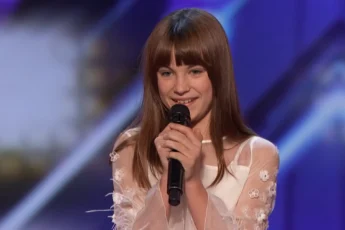
Fourteen-year-old Flau’jae walked onto the America’s Got Talent stage with the confidence of someone much older, but also with the quiet seriousness of a young girl carrying a story that had shaped her entire life. She came from Savannah, Georgia, and from the very beginning, it was clear that her audition was not just about showing off a talent or chasing fame. For Flau’jae, music was personal. It was family. It was memory. It was also a way to speak about pain that too many people know but few are brave enough to turn into art.
Before she performed, Flau’jae opened up about her father, who had been an aspiring rapper himself. He had dreams of making it in music, of using his words and his voice to build a future. But those dreams were cut short when he was tragically killed before Flau’jae was even born. She never got the chance to know him, hear his advice, or watch him perform, yet his presence was still deeply woven into her life. In many ways, the stage became the place where she could feel connected to him. By rapping, she was stepping into the path he had once hoped to walk.
That made her audition much more than a performance. It was a tribute to her father’s unfinished dream, but it was also a statement about the violence that took him away. Instead of choosing a simple song or a safe crowd-pleaser, Flau’jae decided to perform an original rap about gun violence. That choice alone showed an incredible amount of courage. At only fourteen, she was willing to stand in front of millions and speak honestly about grief, loss, and the urgent need for change.
When the music began, the room seemed to shift. Flau’jae did not need flashy staging or dramatic effects to capture everyone’s attention. Her words did that on their own. She delivered each line with sharp focus, moving through the verses with a rapid-fire flow that showed both skill and control. There was energy in her voice, but also pain. There was anger, but it was not careless anger. It was the kind of emotion that comes from living with a loss that should never have happened.
The most powerful part of the song centered on one haunting idea: if the person who pulled the trigger had put the gun down, her father could still be alive. That message hit hard because it was so direct and so human. She was not speaking in abstract terms. She was talking about a father she never got to meet, a life that was stolen, and a future that changed before it even began for her. When she repeated the plea to “put your guns down,” it felt less like a lyric and more like a cry from the heart.
What made the performance even more impressive was how mature Flau’jae seemed on stage. Many performers her age are still learning how to handle pressure, how to connect with an audience, or how to make their emotions clear without losing control. Flau’jae already seemed to understand all of that. She moved with purpose, held the stage naturally, and made every word matter. Her talent was undeniable, but it was the meaning behind the talent that truly made people stop and listen.
The audience responded with the kind of silence and attention that often says more than applause. People were not just watching a young rapper perform; they were witnessing someone transform personal tragedy into something bigger. Her song was about her father, but it also spoke for countless families who have lost someone to violence. In that moment, Flau’jae became more than a contestant. She became a voice for people who know what it feels like when one violent act changes everything forever.
The judges were visibly moved by what they had just seen. Heidi Klum praised Flau’jae for being honest and completely on point, recognizing not only the strength of her performance but also the bravery behind it. Simon Cowell, who admitted that rap music was not his area of expertise, still understood that he had witnessed something special. He told her that he knew talent when he saw it, and he believed they were watching the beginning of a major career. Calling it his favorite audition by a clear mile, Simon made it clear that Flau’jae had made a lasting impression.
By the end of the audition, Flau’jae received four enthusiastic “yeses” from the judges. But the moment felt bigger than simply moving forward in the competition. She had honored her father, shared her truth, and used her voice to speak against violence with remarkable strength.