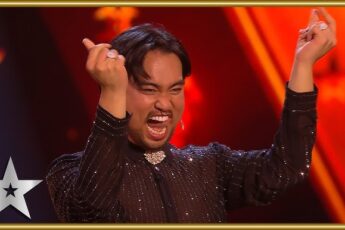
Contestant Aaron Marshall walked onto the Britain’s Got Talent stage with a calmness that gave little hint of what was about to happen. When he announced that he would be performing Disney’s “Let It Go,” the mood in the room immediately shifted into something bright and familiar. The Frozen anthem is one of those songs almost everyone knows, whether they love it, tolerate it, or have heard it far too many times from a child with a plastic microphone. It carries certain expectations: a soaring melody, emotional build-up, and a big, sparkling chorus. For Amanda Holden, who has openly enjoyed the song, the announcement seemed like a welcome surprise.
As the first notes began, Amanda looked visibly delighted. Her face lit up with recognition, and for a brief moment she appeared ready to enjoy a classic Britain’s Got Talent-style musical number. The audience seemed to settle into the same assumption. Perhaps Marshall would give them a powerful ballad, a theatrical pop performance, or even a slightly quirky but still recognizable version of the Disney hit. The familiar instrumentation invited that expectation. It sounded, at first, like the beginning of something warm, polished, and safe.
Then Marshall opened his mouth, and the entire atmosphere changed. Instead of singing the opening lines in a clear, melodic voice, he launched into a raw black-metal version of the song, delivering the lyrics through guttural screams and aggressive, throat-shredding growls. The contrast was instant and almost surreal. A song associated with ice castles, princess dresses, and children belting out high notes in living rooms had suddenly been dragged into a much darker, louder world. The sweetness of the original was replaced by a wall of harsh vocals, and the result was both shocking and strangely entertaining.
Amanda’s reaction was immediate. The excitement disappeared from her face and was replaced by a look of pure disbelief. She seemed not just surprised, but genuinely horrified by what she was hearing. Within moments, she hit her red buzzer, making it clear that, as far as she was concerned, the performance had gone terribly wrong. The buzzer cut through the noise like a verdict, but Marshall did not stop. He carried on with full commitment, roaring his way through the Disney anthem as though he were headlining a metal festival rather than auditioning on a family talent show.
What made the audition even more unusual was the audience’s response. At first, many people seemed unsure whether to laugh, cheer, or simply stare. The performance was so unexpected that amusement rippled through the crowd. But as Marshall continued, something odd and charming began to happen. The audience started joining in with the original melody, swaying their arms and singing along while he screamed the words in his fierce metal style. Their familiar, melodic voices created a bizarre counterpoint to his growls, turning the moment into an accidental duet between Disney nostalgia and heavy-metal chaos.
That strange mixture gave the performance its real energy. On one side was Marshall, fully committed to his intense interpretation, refusing to soften the edges or wink too obviously at the joke. On the other side was the crowd, leaning into the fun of recognizing the song beneath the noise. The result was tense, funny, confusing, and oddly memorable all at once. It was not a beautiful rendition in the traditional sense, but it certainly was not forgettable.
Amanda, however, remained unmoved. After the performance, she made her feelings painfully clear. She said she found it “offensive,” and even joked harshly that she hoped Marshall would “lose your voice this afternoon.” Her disappointment seemed especially personal because she had been so excited when the song began. To her, the performance had taken something magical and beloved and turned it into, as she put it, “every little princesses nightmare.” She gave him a firm “No,” leaving no doubt about where she stood.
The other judges saw it differently. Simon Cowell, David Walliams, and Alesha Dixon were not nearly as offended by the unusual take. Whether they appreciated the shock value, the commitment, or simply the fact that it made the room react, they each gave Marshall a “Yes.” With three votes in his favor, he moved on to the next round despite Amanda’s strong objection.
In the end, the audition became memorable precisely because it divided the room. For Amanda, it was a nightmare version of a song she loved. For the others, it was bold enough, strange enough, and entertaining enough to deserve another chance. Aaron Marshall may not have delivered the “Let It Go” anyone expected, but he certainly gave Britain’s Got Talent a moment people would talk about long after the final scream faded.