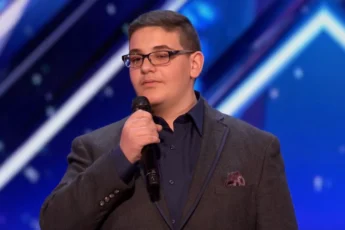
This incredible video captures the deeply emotional audition of Tim Poe, a U.S. military veteran whose story left a lasting impression on both the judges and the audience of America’s Got Talent. From the moment he steps onto the stage, there’s a quiet tension in the air—part curiosity, part respect. Tim introduces himself with visible effort, his words interrupted by a persistent stutter that immediately signals something profound about his journey. It’s not just nervousness; it’s something deeper, something earned.
Tim explains that he served fourteen years in the military, dedicating a significant part of his life to protecting others. In 2009, while deployed in Afghanistan, his life changed in an instant. During an attack, he was struck by a grenade while trying to shield his team. The explosion left him with a broken back and a traumatic brain injury. These weren’t just physical wounds—they altered the way he communicated, leaving him with a noticeable and ongoing speech impediment. As he shares this, there’s no self-pity in his voice, just honesty and quiet strength.
Despite everything he has been through, Tim stands on that stage not just as a veteran, but as someone determined to reclaim his voice—literally and figuratively. He mentions that singing became part of his recovery process during speech therapy. His pathologist had suggested it as a technique to help manage his stutter, something that might allow him to express himself more freely. It’s a small detail, but it becomes the turning point of the entire performance.
When Tim begins to sing “If Tomorrow Never Comes,” something remarkable happens. The stutter that defined his speech completely disappears. His voice comes out smooth, steady, and full of emotion. It’s not overly polished or filled with flashy vocal runs—instead, it’s sincere and grounded, carrying a depth that feels real. The contrast is striking. Just moments before, he struggled to get his words out, and now he’s delivering lyrics with clarity and control, as if the music unlocks a different part of him.
The room shifts almost instantly. You can see it in the judges’ expressions—initial curiosity turns into surprise, then into genuine admiration. The audience, too, becomes completely still, drawn into the performance. There’s something powerful about watching someone overcome such a visible challenge in real time. It’s not just about the quality of his voice; it’s about what that voice represents.
As Tim continues singing, the emotion builds naturally. The song itself, already meaningful, takes on an even deeper significance coming from someone who has faced life-threatening circumstances. Lines about love, time, and uncertainty resonate differently when sung by someone who has experienced how quickly everything can change. His delivery feels honest, almost conversational, as if he’s sharing a piece of himself rather than performing.
By the time he finishes, the reaction is immediate and heartfelt. The judges don’t just applaud—they take a moment to process what they’ve witnessed. Howard Stern and the rest of the panel express not only their appreciation for his musical ability but also their respect for his courage. It’s clear that this wasn’t just another audition. It was a moment of connection, something that went beyond entertainment.
What makes this video so memorable—and ultimately viral—is that contrast between struggle and release. Watching Tim speak, you feel the weight of his injury. Watching him sing, you see his resilience. It’s a reminder that healing doesn’t always look the way we expect. Sometimes, it comes through unexpected paths, like music, offering a new way to communicate when old ones become difficult.
There’s also something quietly inspiring about how Tim discovered this ability. It wasn’t part of a grand plan or a lifelong dream. It came from a simple suggestion during therapy, a practical exercise that turned into something transformative. That detail makes his story feel even more human—proof that even small steps in recovery can lead to something meaningful.
In the end, Tim receives a unanimous “yes” from the judges, but by that point, the outcome almost feels secondary. The real impact lies in the journey he shared and the moment he created on stage. His audition becomes more than just a performance; it’s a powerful example of resilience, adaptation, and the unexpected ways people find their voice again.
For anyone watching, it’s hard not to feel moved. The video stays with you—not because of flashy production or dramatic effects, but because of its authenticity. It captures a rare, genuine moment where vulnerability meets strength, and where music becomes more than sound—it becomes a bridge back to connection.