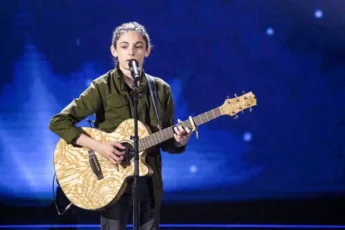
Kieran Rhodes stepped onto the America’s Got Talent stage as a young singer and pianist with a lot to prove. Sitting at the grand piano under the bright stage lights, he looked focused but understandably nervous. Like many contestants, he had chosen a familiar song for his audition, hoping that a beloved classic would help him connect with the judges and the audience. His choice was Billy Joel’s “She’s Got a Way,” a smooth, emotional ballad that gave him a chance to show his voice and piano skills.
At first, the performance seemed calm and polished. Kieran began playing gently, and his voice carried a soft, controlled warmth. The room was listening, but before the song could fully build, Simon Cowell suddenly raised his hand and stopped him. The moment was sharp and uncomfortable. For any performer, being interrupted in the middle of an audition is difficult. For someone standing on such a huge stage, in front of cameras, judges, and a silent audience, it could easily feel crushing.
Simon did not stop him because Kieran lacked talent. Instead, he felt the performance was too safe. A Billy Joel cover could show that Kieran could sing, but it did not show enough of who he was as an artist. Simon wanted something more personal, something that could separate him from every other talented singer who walks onto the show. He asked Kieran if he had an original song.
That question changed everything. Kieran could have become flustered or defensive, but he stayed calm. He explained that he did have an original song called “Disengage,” which he had written during the previous semester. Then he shared the story behind it. The song came from a severe period of depression he had gone through, making it deeply personal and emotionally honest. In that moment, the energy in the room shifted. This was no longer just an audition with a young man performing a cover. It became a moment of vulnerability.
There was something powerful about the way Kieran opened up before playing the song. He was not trying to make the story dramatic or force a reaction. He simply explained where the music came from, and that honesty made people listen differently. The audience could sense that this song meant something real to him. The judges also seemed more focused, waiting to hear not just his voice, but his story.
When Kieran began playing “Disengage,” the performance immediately felt different from the first one. This time, he was not singing someone else’s words. He was sharing his own. His hands moved across the piano with quiet confidence, and his voice carried a raw, emotional quality that made the lyrics feel lived-in. The song had moments of softness and moments of strength, almost like it was moving through pain, confusion, and the slow process of trying to heal.
What made the performance so memorable was not only Kieran’s vocal ability, though his voice was strong and expressive. It was the feeling behind every note. The song allowed him to show his identity as a songwriter, not just as a singer. It gave the judges a clearer picture of the kind of artist he could become. Instead of hiding behind a famous song, he stood fully in his own experience and let the music speak for him.
By the time he finished, the mood in the room had completely changed. The interruption that could have destroyed his confidence had actually led him to the most important part of his audition. The judges were visibly moved, and Simon Cowell, who had stopped him in the first place, responded with real admiration. He praised Kieran’s courage and talent, and even shared a rare personal reflection about his own early struggles in the music industry. It was clear that Simon respected not only the song, but the bravery it took to perform it.
The rest of the panel was supportive as well. They recognized that Kieran had taken a difficult, high-pressure moment and turned it into something meaningful. With unanimous “yes” votes, he moved forward in the competition. More importantly, he proved exactly what Simon had been looking for. Kieran Rhodes showed that he was not just a young pianist with a pleasant voice. He was an artist with something real to say.