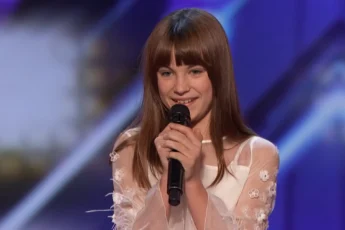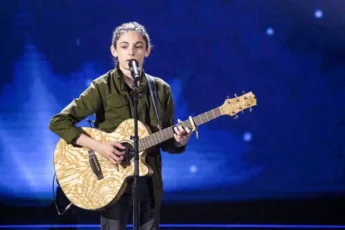
Thirty-nine-year-old Glennis Grace stepped onto the America’s Got Talent stage with a quiet confidence that came from years of experience, but also with a sense of unfinished business. She introduced herself not as a newcomer, but as someone who had already spent a significant part of her life singing. Still, despite everything she had done, she explained that her dream hadn’t changed. She simply wanted to reach more people, to share her voice on a bigger stage, and to finally break through in a way she hadn’t yet managed to. There was something both humble and determined in the way she spoke, as if she knew exactly what she was capable of but was still waiting for the world to catch up.
One of the most touching parts of her introduction was the role her 11-year-old son, Anthony, played in her journey. Glennis shared that he was her biggest supporter, constantly encouraging her to keep chasing her dream. It wasn’t just casual support—it felt like genuine belief. You could imagine those small, everyday moments behind the scenes: a child reminding his mother not to give up, telling her she deserved a bigger audience. That kind of motivation added an emotional layer to her performance before she even sang a single note. The judges seemed to pick up on that as well. They weren’t just listening to another contestant; they were watching a mother trying to prove something not only to the world, but also to her son.
When Glennis revealed her song choice—“Run to You” by Whitney Houston—it immediately raised the stakes. Whitney Houston is not just any artist; she’s one of the most iconic vocalists of all time, and covering her songs comes with enormous pressure. It’s the kind of choice that can either elevate a singer to unforgettable heights or expose their limitations within seconds. The judges leaned in with curiosity, fully aware of the challenge she had just set for herself.
From the very first note, however, any doubt in the room seemed to disappear. Glennis’s voice carried a richness and power that instantly filled the auditorium. What stood out wasn’t just her technical ability, though that was clearly exceptional—it was the emotion behind every phrase. She didn’t rush the song or try to overpower it. Instead, she allowed it to build naturally, controlling each note with precision while still delivering the raw feeling that made the original so powerful. There were moments where her tone was so strikingly similar to Whitney Houston’s that it gave people chills, yet it never felt like imitation. It felt like a tribute infused with her own identity.
As the performance continued, the audience became completely absorbed. You could see it in their faces—the kind of stillness that only happens when people are truly listening. By the time she reached the song’s most demanding sections, she handled them with ease, hitting high notes with clarity and strength, never losing control. It wasn’t just impressive; it was captivating. The final note lingered in the air for a moment before the entire room erupted into applause.
The standing ovation came almost instantly. The judges were visibly stunned, exchanging looks that said more than words could. Simon Cowell, known for his brutally honest critiques, didn’t hold back his reaction. He admitted, “I feel like I’m looking at a star already, I’m going to be honest with you.” Coming from him, that kind of statement carried serious weight. It wasn’t just a compliment—it was recognition.
Mel B echoed that sentiment, focusing on the uncanny resemblance in vocal tone. She said, “You do sound so much actually like Whitney, it’s unbelievable.” It was perhaps one of the highest praises Glennis could receive, considering the song choice. At the same time, it highlighted just how rare her voice was. Howie Mandel added another perspective, pointing out something simple but powerful: “The only reason why you’re not a star yet is because we haven’t seen you and we haven’t heard you.” That line captured the essence of the moment perfectly. It wasn’t about potential anymore—it was about exposure.
By the end of the audition, the result felt inevitable. Glennis Grace received four strong “yeses,” but more importantly, she left the stage having made a lasting impression. It wasn’t just a successful audition; it was a moment that suggested something bigger was beginning. Her dream, which she had carried for so many years, suddenly felt closer than ever—not just for her, but for everyone who had just witnessed her performance.